Sunday, 3 March 2013

Review: SPLAT! by The Famous Lauren Barri Holstein


by Mary Paterson

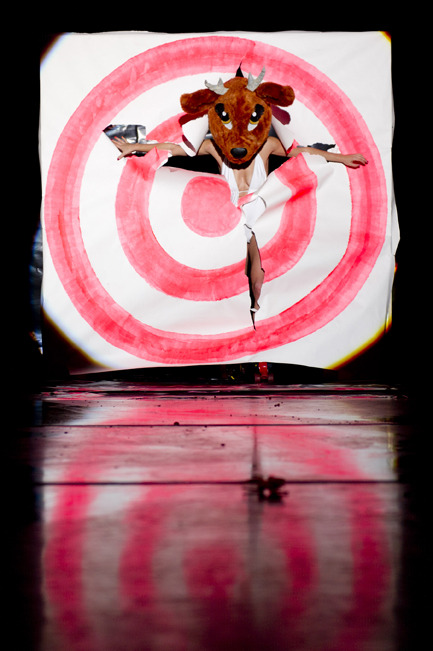
A figure roller-skates blindly across the stage, her vision obscured by a giant deer mask, her arms flailing at either side, her voice singing karaoke-style to a Disney ballad.  Half girl, half Bambi, the skidding ingĂ©nue slips and slides over tomato juice, topples, wavers and almost falls, before a team of assistants rushes to her aid.

image

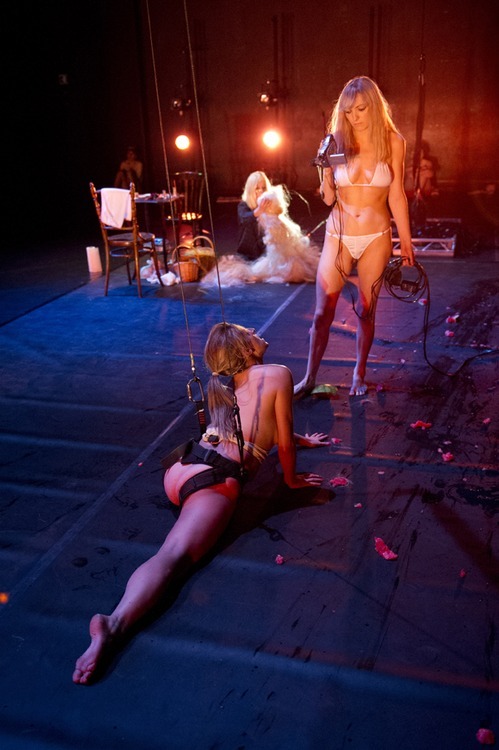
This scene is one of a dizzying array of feminine stereotypes played outrageously  by The Famous Lauren Barri Holstein in Splat!  Here, she parodies a cutesy cartoon princess, held up (literally) by an entourage who whose devotion simply highlights her dependence on others.   Elsewhere, the performer and her semi-naked, female assistants perform a range of roles including bad tempered porn star, mute doll, exploited sex object, fairy-tale narrator, murdered body and soppy victim of heartbreak.

For Lauren Barri Holstein, the acting starts before the show begins.  ‘The Famous …’  is, of course, a self-declared star.  What she is famous for is not important - her name, like the products of her visual metamorphoses, is both a statement and an ambition.  And, just like those visual changes, this declaration is less a form of identity than a claim to objecthood.  By describing herself as ‘The Famous …’ Lauren Barri Holstein sets out how she wants to be seen.  She’s not a woman play acting at celebrity – she is the very expression of  fame.  She’s not a woman who happens to be dancing (whether she’s performing in the guise of a Disney lead, a figure from an 80s film, or a demented R&B star) – she is the eternal dancing girl.
image

Even the artist’s desperation to be seen is a kind of parody-paradigm of femininity .  As John Berger wrote in 1976, “men act, women appear”, so controlling what other people see is, in a twisted way, how women can access the means of their own production.  Lauren Barri Holstein struts across stage like an early-80s Madonna, adopting a bossy demeanour (she orders her assistants around like slaves), an air of affected boredom (she moves between scenes as if it’s a burden to be there) and a casual, erotic awareness of her own image-making. 

But ventriloquism is a precarious kind of identity.  

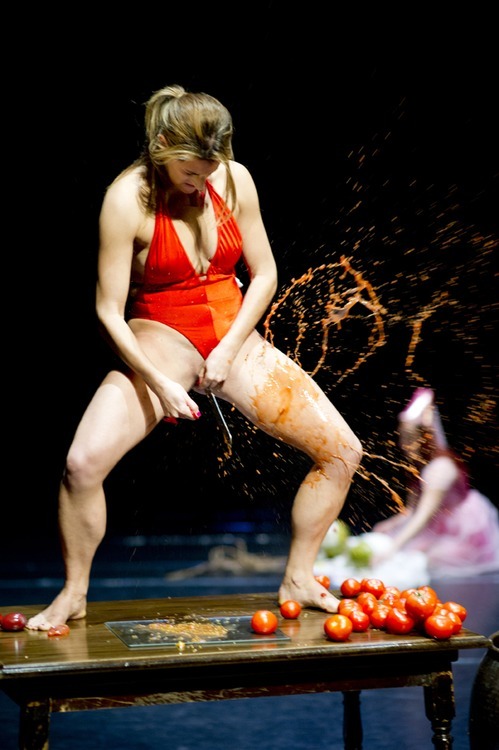
As part of this image controlLauren Barri Holstein forces her parade of underdressed assistants to film her travails, projecting a close up of her squashing tomatoes between her thighs, for example, to a large screen at the back of the stage.  But there is also a single, male, fully dressed photographer who lurks around the edges of the show.  This man does not seem to be under the star’s control.   He photographs Lauren Barri Holstein even when she asks him to leave, and his photos remain hidden inside his camera.   In a single moment, the iconic 80s Madonna becomes a vulnerable noughties Jordan, her picture taken and reused by those who don’t recognise her objecthood as power.

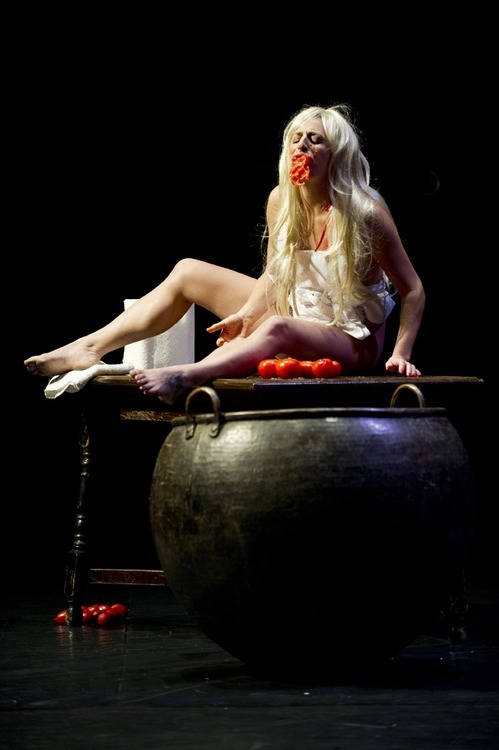
Indeed, it’s the relationship between objecthood and power that sits at the centre of Splat!   Or rather, it writhes around in a vat of tomato juice, either waving or drowning.  With each new identity that Lauren Barri Holstein shrugs on like an invisibility cloak, Lauren Barri Holstein herself disappears.  This is partly because of the dramatic pointlessness of the task –  it is of course a mainstay of feminism that a person cannot exist within a series of roles typecast from the outside.   But the disappearance is also because the accumulated effect of multiple identities breaks down the mirage of appearance itself.  Now a sexual predator, now a perpetrator of misogyny, now a fetish of desire, the variety of objecthoods Lauren Barri Holstein puts on display undermines any claims they have to representation.  If a woman is either a virgin or a whore, then what are you looking at when you see her slip gracelessly between the two?    
image

Another way of describing this variety could be as a kind of excess - Splat! is an excess of (tropes of) femininity, baring their bones until their guts spill, lifeless, onto the floor.   And excess is indeed the defining principle of the show: each scene explodes with more bodies, more representation, more confusion. 

But, inside Splat, excess becomes a kind of trope as well.  Or, more accurately, this excess is not so much excessive, as conventional – albeit conventional in an alternative, performance art kind of way.   The food-mess  poured over young bodies recalls the artist Carolee Schneemann’s seminal performances like Meat Joy (1964)for example, while Lauren Barri Holstein’s impatient persona draws obvious comparison to the artist Ann Liv Young.  Long passages in Splat are spent reading an alternative fairy tale in which a pliant female character explores the pleasures and dangers of her sexuality – a shadow, perhaps, of a revision by the feminist author Angela Carter. 

In this context, it’s unclear whether excessive behaviour is being parodied as one more feminine trope that has been normalised beyond meaning, or whether it’s appearance is a genuine grab for power.  

On one hand, these behaviours are now part of the encyclopaedia of voices available to women – identify with a pop star, or a princess, or a 1960s performance artist.   But, just like Madonna’s 80s attitude, their efficacy has been dulled by distance from the socio-political context in which they were conceived.  On the other hand, these devices of excess have a special status within Splat!: they define its structure and limit its content.  Food-blood-bodily fluids accumulate onstage throughout, the fairy tale pulls the only narrative thread, and each new scene adds to a catalogue of excessive representations.  As I watch the chaos pile up on stage, I wonder if  Lauren Barri Holstein is making fun of the styles of radical feminist performance art, with the same wide eyed cruelty she uses to pull apart Disney’s saccharine charm.  Or has she mistaken the tropes of stylistic excess for real power?
image

None of Lauren Barri Holstein’s relationships are simple.  She seems to hold genuine affection for power ballads, princess dresses and roller-skating Bambis, even while she squashes their dreams like melons dropped from a great height.   So perhaps it is only my prejudice that imagines she takes the sacred cows of performance art too seriously.  Unlike Disney,  I hold Carolee Schneemann to be important and admirable, and while I can laugh at Disney in almost any context, Schneemann commands a different kind of attention.  But I also know that what was radical in 1964 is not radical in 2013; the grandmothers (or even the aunts and sisters) of feminist performance art cannot be copied, only revised.  I long for someone with a name like ‘The Famous Lauren Barri-Holstein’ to tell me what feminism can be, what women can be, in the twenty first century. 

But of course, that’s not her job.  I’m sure if you asked her, Lauren Barri Holstein would say she’d rather hang upside down and eat a hamburger.  The show ends with what can only be described as a masterstroke of visual spectacle, and it’s at moments like this – brash, bizarre and fiercely independent – that ‘The Famous …’ lives up to her self declared name.

Friday, 1 February 2013

THE DARK WOULD

By Rachel Lois

Stephen P Perry and I are pleased to let you know that our contribution to the forthcoming language art anthology THE DARK WOULD will be launched at the Southbank Centre in London on 6 Feb 2013, 8-9.30pm and the Whitechapel Gallery 11 April, 7-9pm. 


Image: C. The Dark Would 2013


Our one page piece for the anthology is entitled 'Q & A', and is a biography taken from a larger unpublished work entitled HOLD IT, developed by Stephen P Perry and I from a 2012 performance at The Other Room. The piece plays with the limitations of printed biography and occupies the particular space between questions and answers, questions and questions, and answers and answers (infinitum).


THE DARK WOULD is a pioneering anthology of text artists and poets, edited by Philip Davenport, which includes work by over 100 contributors including Richard Long, Fiona Banner, Maggie O' Sullivan, Tacita Dean, Ron Silliman, Shin Tanabe, Marton Koppany, Tsang Kin-Wah, Charles Bernstein, Susan Hiller, Tony Lopez, Caroline Bergvall, Sarah Sanders, Kay Rosen, Robert Grenier and many, many more.

THE DARK WOULD comes in two volumes, one paper and one virtual, sold both together for £29.99, published by Apple Pie Editions. 

Stephen and I hope you enjoy this amazing book.


Sunday, 6 January 2013

Inside Performance Volume 24 no. 4 2011

By Rachel Lois


Misalignments in this issue of Dance Theatre Journal yield interesting thoughts about editing, published mistakes and the columns of my columns.


Inside Performance for Dance Theatre Journal  Volume 24 no. 4 2011, entitled Writing AVANT GARDE PERORMANCE OR, is written in two vertical columns to a page. The columns are read in parallel, moving towards and bouncing off each other at certain critical points.

The left hand column is the dominant narrative outlining key critical aspects of US writer Richard Kostelanetz’s On Innovative Performance(s), Three Decades of Recollections on Alternative Theater ; a fascinating thirty year collection of Kostelanetz's typed notes-cards from the burgeoning 1960-1980 New York performance art scene. Staying close to On Innovative Performance(s) the left column presents excerpts from Kostelanetz's text, posits the context for his work, and outlines his outsider position in relation to the mainstream New York and dominant theatre press, including his living and working within a small circle of Manhattan artists (an infamous roll-call of performance pioneers such as John Cage, Merce Cunningham, Alison Knowles, Nan Goldin, Deborah Hay, Dick Higgins and Ann Halprin amongst others). The left hand column touches upon Kostelanetz’s critical modus operandi, his writerly rootedness to Manhattan, and his sometime lay approach to experimental performance. The text also speculates on the familiar patterns of the performance Avant Garde (professional exclusion, public incomprehension, gathering a small yet loyal following and eventually leading to widespread critical acclaim) and the scene's inherent smallness.


Running alongside, the right column often accompanies the left in the form of no comment or long silences (blanks). At other times the right column openly interrogates ideas in the left and is more aphoristic and circumspect in tone. 

Left column (An excerpt from Richard Kostelanetz's On Innovative Performance(s)):

Vito Acconci
Claims (private loft, 93 Grand Street). 
I’d not seen any of Vito’s new performance pieces-at least not since the deep breathing at N.Y.U a year and one-half ago, which I liked more in contextual retrospect than I did then. Always ‘experimenting with himself’ so to speak, he sets up a situation hazardous, initially to himself, whose results compromise the piece. For example, he had the Post Office forward his mail to the Museum of Modern Art, where he had to go and pick it up. Or he does the same exercise (such as jumping on and off a stool) for a fixed period of time every day. Or he burns the hair off his chest. The term ‘body art’ might be appropriate, because what happens to his body is now the content. ‘Conceptual Art’ is really a more accurate epithet. For Claims Vito sat at the bottom of a stairway with a collection of long poles. Blindfolded, he assigned himself the job of protecting his territory – the bottom of the stairway- from intruders. A close-circuit camera was trained on him, and the results were immediately broadcast ‘live’ on a TV monitor upstairs, as well as recorded on videotape. Thus, his voice could be heard not only through the door leading downstairs but also over the electronic playback system. He did this for a full four hours, constantly mumbling to himself that he had to protect his territory; but nothing else ‘happened’ or changed in the course of the performance. The audience never numbered more than a dozen people, most of whom were (like me) his friends. (September 1971) 

Right column:

I do find myself wanting to question 1960’s – 1980’s New York as bedrock for AVANT GARDE PERFORMANCE.  Maybe this kind of reverse reflection is a symptom of the AVANT GARDE. The smallness that once was in part its generative appeal, to both those both inside and out, festers and begins to look flawed upon insertion into the history books. To this end, it is interesting to note that Kostelanetz recalls Carolee Schneeman ‘feeling excluded’ from the then PERFORMANCE scene. Perhaps then, hindsight is not required in order to see the AVANT GARDE as insular (in this case as a predominantly North American white, male domain).

The misalignment of the text in Volume 24 no. 4 2011 gives way to several new readings from left to right. 

Left column:

On Innovative Performance(s) comprises of thirty years worth of 4 x 6” typed note-cards that Kostelanetz  made from PERFORMANCEs he saw between 1960 and the late 1980’s.  For publication the note-cards were sifted through, re-typed and sorted into alphabetical order by artist name. Several contextualising essays on experimental PERFORMANCE are also re-printed. As a collection, it remains almost entirely unedited from the original cards.

Right column:

Indeed.

The mistakes continue through the text with varying degrees of success. My particular favourite is pictured and re-typed below. 


Left column (An excerpt from Richard Kostelanetz's On Innovative Performance(s)):

Vito Acconci
Claims (private loft, 93 Grand Street). I’d not seen any of Vito’s new performance pieces-at least not since the deep breathing at N.Y.U a year and one-half ago, which I liked more in contextual retrospect than I did then. Always ‘experimenting with himself’ so to speak, he sets up a situation hazardous, initially to himself, whose results compromise the piece. For example, he had the Post Office forward his mail to the Museum of Modern Art, where he had to go and pick it up. Or he does the same exercise (such as jumping on and off a stool) for a fixed period of time every day. Or he burns the hair off his chest. The term ‘body art’ might be appropriate, because what happens to his body is now the content. ‘Conceptual Art’ is really a more accurate epithet. For Claims Vito sat at the bottom of a stairway with a collection of long poles. Blindfolded, he assigned himself the job of protecting his territory – the bottom of the stairway- from intruders. A close-circuit camera was trained on him, and the results were immediately broadcast ‘live’ on a TV monitor upstairs, as well as recorded on videotape. Thus, his voice could be heard not only through the door leading downstairs but also over the electronic playback system. He did this for a full four hours, constantly mumbling to himself that he had to protect his territory; but nothing else ‘happened’ or changed in the course of the performance. The audience never numbered more than a dozen people, most of whom were (like me) his friends. (September 1971) 

And the right column simply: Hmm.

I am struck by the new levels of meaning created in relation to this comparatively niche publication by Kostelanetz. It has me wondering. Examples of essayistic misprints are no doubt numerous throughout history. An anthology of such texts, bound together in their full and wrongful glory, to my knowledge has not recently been published and seems overdue. 

//

Inside Performance is a serialised writing project developed by Rachel Lois Clapham for Dance Theatre Journal that takes the form of a regular newspaper or magazine column. The column features Rachel Lois' own writing on and as performance, as well as conversations, commissions, page works and texts from other artists.

Previous columns in the series


///

Dance Theatre Journal is the UK's leading magazine for dance and live art. Published four times a year, it contains reviews, features, interviews and in-depth discussions by leading dance writers and artists, as well as talented new writers. It also includes up-to-date listings of dance performances and workshops throughout the UK.

Open Dialogues is a UK collaboration, founded by Rachel Lois and Mary Paterson in 2008, that produces writing on and as performance. www.opendialogues.com


Sunday, 11 November 2012

NOTA : SHOWTiME Collection


NOTA (NOT, NOTES, NOTER (NOTA), NOT/A), towards a sometimes set of performance writing tools.  NOTA is a research framework for Open Dialogues that presses on the time, place and quality of notes in relation to live performance.  

The NOTA : SHOWTiME Collection is a
selection of Open Dialogues notes from the launch of NOTA at SHOWTiME, Rich Mix London July 2012. The collection features notes made by Rachel Lois and Mary live and in public from a writing station on the SHOWTiME stage.


NOTA 150612 20.00 1
 START

OK, how do you want to start? Have I got a coffee moustache? Let’s not start there...

The stamp

Maybe start with the actual stamp... There is a lot in the gesture, or the action of the stamp. It is really old fashioned...

 It’s a standard stationery item in many ways, off the shelf. Only one part of it is customised - the word ‘NOTA.’ I tried to get the word ‘received’ removed from it too but then decided against it.


NOTA 160612 20.00 3

... This is graft. We are at a workstation, stamping documents. And it is work.


NOTA 160612 22.00 1


For me, it’s a process of thinking through writing, through mark making. The notes represent my thought processes.

Provisional, lightweight and ‘un-publishable’, the notes capture a particular insight. The particular invitation they make is important. As a form of conversation there is space for other people to speak.

The first of several NOTA publications is due out soon. It will feature some of the SHOWTiME notes specially selected and re-worked by Alex Eisenberg and John Pinder of Present Attempt and a choreographed interview transcript between Mary and Rachel Lois.

 //

NOTA (NOT, NOTES, NOTER (NOTA), NOT/A), towards a sometimes set of performance writing tools.  NOTA is a research framework for Open Dialogues that presses on the time, place and quality of notes in relation to live performance.  

SHOWTiME is curated by Present Attempt. The July 2012 event  included Haranczak/Navarre Performance Projects, Present Attempt, Joseph Mercier, Mischa Twitchin and Penny Francis, ChloĂ© Dechery, Rachel Mars and Rosie Kelly, Bill Aitchison Company, Lisa Jeschke and Lucy Beynon, Augusto Corrieri, Seke Chimutengwende & Friends, Yoko Ishiguro.

Open Dialogues is a UK collaboration, founded by Rachel Lois Clapham and Mary Paterson, that produces writing on and as performance. 


Friday, 9 November 2012

Month of Performance Art- Berlin

By Rachel Lois


I am part of the international Curatorial Collaboration Initiative (CCI) for the Month of Performance Art- Berlin (MPA-B) 


Programme B with Ying-Mei Duan and Elana Katz - May 22nd - Photo © Marco Berardi 2012


The CCI consist of an international panel of curators, theorists and artists who contribute to the production, programming, promotion and network development of MPA-B, with discussions happening in Berlin,  online via Wiki and Skype. The 3rd MPA-B is in May 2013 and the CCI November 2012 meeting will focus on the dissemination of authorship in performance. Join in, and contribute to the conversations via live written chat via the livestream between 11-17.00 CET 10 November 2012. 

Texts from the collaboration will be published on the MPA-B Text roll here, a selection of these will also feature here on the Open Dialogues blog 


Sunday, 4 November 2012

Strategies for Approaching Repeating Problems

By Rachel Lois


Emma Cocker & Rachel Lois Clapham, Fatima Hellberg, Gil Leung, Andrew McGettigan, Francesco Pedraglio, David Raymond Conroy, Alex Vasudevan


Re — Rachel Lois Clapham and Emma Cocker, presented at Quad, 2012
Strategies for approaching repeating problems presents a series of performances, presentations and talks around the ideas explored in the exhibition, Accidentally on Purpose, at Quad. Taking the notion of a repeating problem as a starting point, invited artists, writers and curators discuss elements of their practice within this framework. Notions of recurring issues are explored from artistic and wider social perspectives; from difficulties inherent in language and communication; to the way artists and writers position themselves in relation to political events and wider social issues.


Re — Rachel Lois Clapham and Emma Cocker, presented at Quad, 2012

For Strategies for approaching repeating problems, Emma Cocker and I performed a new version of Re — an ongoing iterative project that essays the relation between meaning and intention, hesitation and purpose, and the visible and invisible states of not knowing within the event of practice. Re —  presses on two writers coming together to explore process, product and performance (of text).


More details on the event here or here


Sunday, 21 October 2012

#networkwriting


A week of dialogue between Mary Paterson and Nathan Jones (Mercy Online) in relation to 'PERFORMANCE WRITING NETWORK.'

Starts on the Performance Writing page on Facebook (19/10/12)

Continues on Netbehaviour (21/10/12)

More details to be updated soon